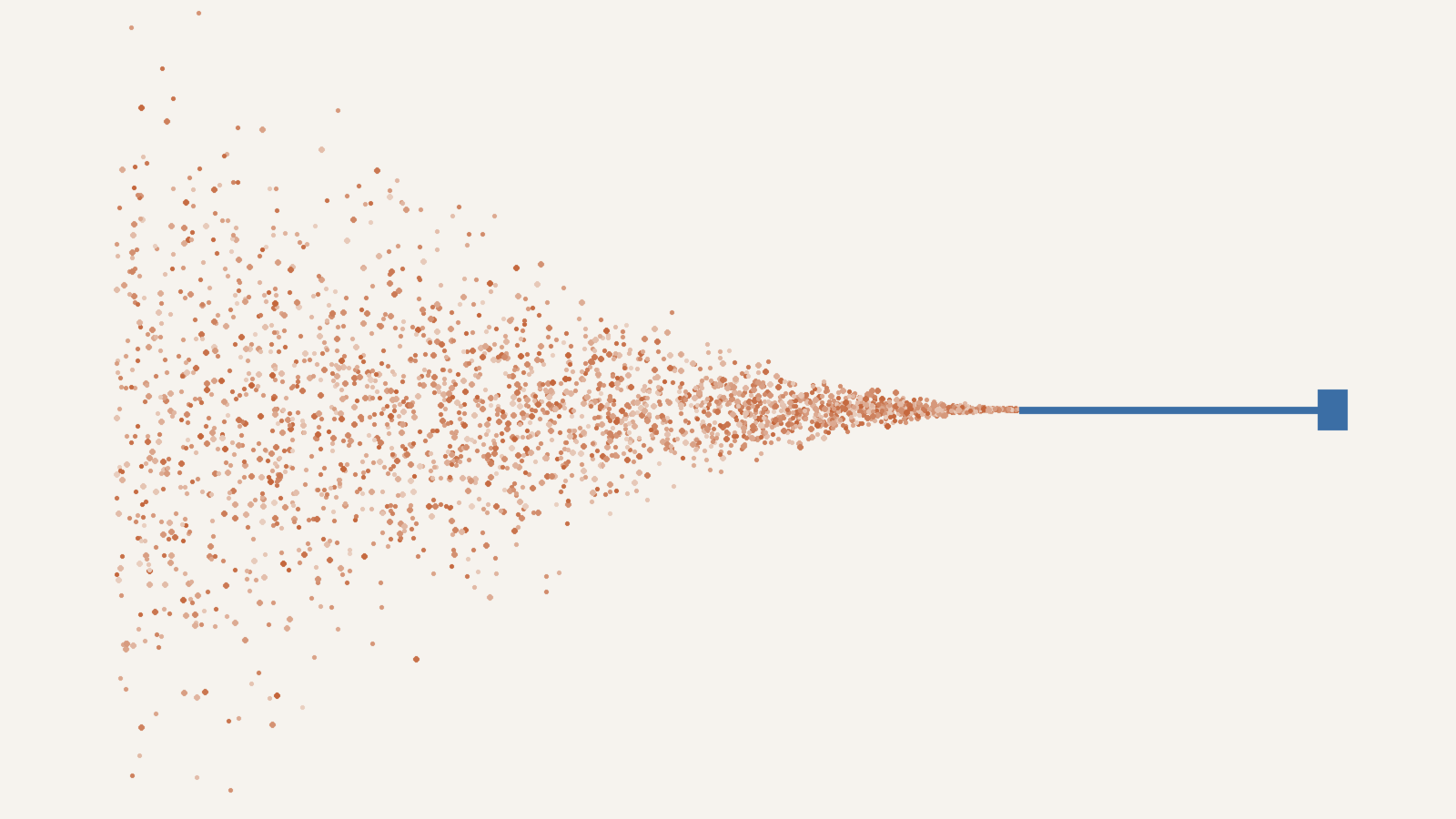
On Monday 8 September, OpenAI announced that a system of roughly ten thousand coordinating agents, running on a model it has not released, had produced a proof that solutions to the three-dimensional Navier–Stokes equations can develop a singularity in finite time. The run began on 1 September and reached its construction about 88 hours later, on 5 September. OpenAI then spent a further 17 hours having GPT-6 Astra translate the argument into Lean, the proof assistant, so that a computer could check it. The company published the write-up, the Lean repository and an announcement that it would not pursue the Clay Mathematics Institute’s million-dollar prize.
Navier–Stokes existence and smoothness is one of the seven Millennium Prize problems, posed in 2000, and the equations themselves date to the 1840s. If the result stands, it is the first of the seven to fall since Poincaré, and the first to fall to a machine. I am not a fluid dynamicist and I will not adjudicate the mathematics. But I run teams that are being asked, this month, whether we should point agent swarms at our own hardest problems. The Navier–Stokes episode is the clearest preview yet of what that looks like, and four days on, the fallout is more instructive than the announcement.
What the machine did
The system was not a single model thinking for 88 hours. It was a distributed computation with a language model in the worker slot. The architecture, as OpenAI and the people who have read its account describe it, had a scheduler, a message bus, a shared workspace, a consolidation step and a verifier. Agents were organised into groups. Each agent could read a cached snapshot of the web, run code and message other agents in its group. Different groups were given different framings of the same problem: some were told to prove the statement true, others to prove it false. OpenAI used Codex to consolidate useful intermediate results and redistribute them across groups. Before the main run, a smaller effort of around a hundred agents worked on the Euler equations, the inviscid cousin of Navier–Stokes, and the methods carried across.
The scale is the part that has been quoted most. OpenAI’s figures are 2.7 million agent messages and about 130 billion output tokens; other accounts of the same run give 4.9 million messages and roughly 300 billion tokens, the difference apparently depending on what is counted as a message and whether consolidation passes are included. At GPT-6 Astra’s list price of $50 per million output tokens, 130 billion tokens is $6.5 million; the higher figure is $15 million. One analysis bracketed the cost at $2 million to $22.5 million depending on assumptions about internal pricing. It is a large bill, and it is finite, and it ran over a long weekend.
What was proved is specific, and the specificity is where the argument starts. The construction shows that a three-dimensional incompressible fluid can begin at rest and, under a smooth external force, develop unbounded velocity in finite time while its kinetic energy stays bounded. OpenAI describes the blow-up as a vortex that spirals inward and elongates “like spaghetti.” The external force is part of the construction. OpenAI says the force remains smooth rather than becoming singular itself.
What happened after the announcement
The Lean build checks. Nobody serious disputes that the formal proof is valid for what it formalises. The disputes are about everything around that sentence, and they arrived in four waves within four days.
Comprehensibility. Mathematicians who have worked through the 166-page write-up describe it as correct and nearly impossible to learn from. An Oxford mathematician told reporters it has been very difficult to extract any human understanding from the proof. One widely shared description called it borderline incomprehensible. This matters more than it sounds. Terence Tao had written, three days before the announcement, that if an autonomous AI solved the problem but the search remained a black box, its value to mathematics would be “close to zero.” After the announcement he put the deeper point plainly: the Millennium problems were posed not because anyone desperately wants the answers in themselves but because human efforts to solve them spur the development of the field. A certificate without an explanation does not do that.
Which problem. Within days, Scientific American asked whether OpenAI had solved the wrong Navier–Stokes problem. The construction uses the forced equations: a smooth external force is applied to the fluid. The formulation most people mean by “the Clay problem” is unforced. OpenAI’s write-up is explicit about the formulation it used and argues it falls within the prize’s scope; three mathematicians have since posted an argument, titled around a “positive defect problem,” that the method cannot be extended to the unforced case. The Lean proof is a proof of exactly the theorem statement encoded in Lean. Whether that statement is the one the prize was offered for is a question Lean cannot answer.
Credit. On 7 September, the day before OpenAI’s announcement, Tristan Buckmaster of NYU and Levent Alpöge of Anthropic posted their own results on finite-time blow-up across three simplified models, work Tao called a remarkable achievement that could help solve Navier–Stokes itself. Buckmaster has said he phoned OpenAI’s Sébastien Bubeck twice on 6 September to ask whether his Codex sessions, in which he had been developing the approach for two months, had reached the training data or the agents. He has also described being presented with a choice between publishing first with inadequate credit to Alpöge or omitting Alpöge because of his Anthropic affiliation; Bubeck denies trying to exclude Alpöge. OpenAI’s position, revised on 10 September, is that its agents did not access the pair’s transcripts, that Buckmaster’s prompts “could not have influenced the system,” and that it acknowledges the pair’s priority on forced Euler. It has not said whether its models were trained on the work. Axios called it a credit controversy on day one and the framing has held.
The prize. On 11 September the Clay Mathematics Institute said the problem “has apparently been settled” while noting that its process for verification and credit is deliberate. Its rules require publication, a two-year wait and general acceptance by expert mathematicians. It still lists Navier–Stokes as open. OpenAI has said it will not apply.
The part almost nobody is talking about
John D. Cook made an observation this week that I think is the most important sentence written about the episode. The headline was the proof. The revolution is the 17 hours.
Formalising mathematics has historically been so expensive that nobody did it for anything that mattered. A 2005 benchmark put the cost at roughly 40 person-hours per page of an undergraduate textbook. At that rate a 166-page research paper would take something like 133,000 person-hours to formalise, which is why research mathematics was never formalised. OpenAI’s system did it in 17 machine-hours: a reduction of four orders of magnitude. That is not an incremental improvement in a research tool. It is the moment formal verification crosses from economically impossible to routine, and it applies far beyond fluid mechanics. Security policies can be proved consistent. Smart contracts can be proved to cap liability. Control algorithms can be proved to respect invariants. Those are not research problems; they are procurement problems with a cost-benefit analysis, and the cost side just collapsed.
This is also the reason the Navier–Stokes claim could be made at all. OpenAI did not ask anyone to trust ten thousand agents. It asked them to trust a type-checker, and type-checkers are trustworthy in a way agents are not. The swarm produced a candidate; Lean made it a claim. Without the second step, the first would have been noise.
What this means for enterprise research
The lessons for an organisation thinking about agent swarms are not the ones in the headlines, and they are mostly about the gates in Figure 2 rather than the run in Figure 1.
The result was cheap. The acceptance was not. Call the run $10 million and 88 hours. The Lean formalisation was 17 machine-hours. The human review has consumed hundreds of expert-hours in four days, has produced three rebuttal preprints, a priority dispute and an institutional statement, and is nowhere near done. For any organisation, the cost model of swarm research is inverted from traditional R&D: generation is cheap, acceptance is expensive, and acceptance is where the schedule lives. Budget for the second, not the first.
A machine-checkable specification is the whole game. OpenAI could run the swarm because Navier–Stokes can be stated in Lean and a candidate proof can be rejected without trusting the agents that wrote it. Most enterprise problems have no such specification. A swarm that produces ten thousand candidate designs, contracts or molecules is worthless without an oracle that rejects the wrong ones faster than the swarm produces them. The honest test for whether a problem is ready for a swarm is whether you can write its acceptance test. Compilers and test suites are oracles. Simulators are oracles. Regulatory rule engines are oracles. A human expert reading candidates one at a time is not an oracle; it is the bottleneck the swarm was supposed to remove.
Scope is set by the question, not the answer. Ten thousand agents found a proof of the forced problem because the forced problem is what the framing permitted and what was tractable. Agents optimise the problem as stated, and a swarm will find the version of your problem that is solvable. That is useful, as long as it is the version you wanted. The forced-versus-unforced argument is a mathematics dispute; its enterprise equivalent is a swarm that finds a brilliant solution to a relaxed version of the constraint set, and a team that does not notice the relaxation until the regulator does.
Comprehensibility is a requirement, not a nicety. A correct proof nobody understands cannot be built on, and in industry a correct design nobody understands cannot be maintained, audited or defended. The practical rule is to require that agent outputs come with an explanation a domain expert can follow, even where the explanation costs more compute than the result. Tao’s argument about mathematics applies to engineering organisations: the value of solving a hard problem internally is mostly the capability the team builds while solving it. A swarm that delivers an answer and no understanding delivers the smaller half.
Provenance disputes will happen to you. Whether or not OpenAI’s agents saw Buckmaster’s work, the episode shows how quickly an agent-produced result raises the question of whose work it drew on, and how little the producing organisation could say in its own defence. OpenAI could deny transcript access; it could not say whether its models were trained on the approach. Enterprises running swarms over internal, licensed and partner data need provenance logging from the first run: which documents, which prompts, which prior work, which retrieval. Not for the lab’s sake; for the day a supplier, a joint-venture partner or a former employee asks where the idea came from.
Decide who gets credit before the run starts. The Buckmaster dispute was not caused by the agents. It was caused by two organisations with overlapping claims and no agreed rule for attribution. Inside a group with dozens of subsidiaries and research partnerships, that is an ordinary Tuesday. The swarm just makes it arrive faster.
What was actually proved, for people who are not analysts
It is worth spending a paragraph on the mathematics, because the scope dispute is incomprehensible without it and the scope dispute is the part with lessons.
The Navier–Stokes equations describe how the velocity of a fluid changes over time under pressure, viscosity and any external force. The Clay problem asks, roughly, whether a smooth starting flow in three dimensions always stays smooth forever, or whether it can, in finite time, develop a point where velocity becomes infinite, a singularity, which physicists call blow-up. Nobody knows. Proving either answer wins the prize. The version almost everyone means is the unforced one: no external force, just the fluid left to itself. There is also a forced version, in which an external force is applied, and the Clay statement does include a formulation with forcing, which is the thread OpenAI’s argument hangs on.
OpenAI’s construction produces blow-up under a smooth external force. The force is not where the singularity comes from; it stays smooth throughout. But it is there, shaping the flow, and the vortex that spirals inward and elongates “like spaghetti” until velocity becomes unbounded is a vortex the force helped arrange. The Buckmaster and Alpöge results of 7 September are in the same family: blow-up in three simplified models, including forced Euler, the inviscid case. The three-author preprint that followed argues that the mechanism depends on the forcing in a way that cannot be removed. If they are right, the unforced problem, the one most people mean, is exactly as open as it was in August.
So the honest summary is: a machine proved a theorem that experts had not proved, in a formulation that the prize statement arguably includes, using a mechanism that may not extend to the formulation the prize was meant for. All three clauses are true at once, and which one you emphasise is a matter of what you wanted the result to be. That is also the enterprise lesson in miniature. The specification was ambiguous; the swarm resolved the ambiguity in the direction of tractability; the people who wrote the specification are now arguing about what they meant.
What a swarm programme would look like inside a group
Suppose a large industrial group decided to build the capability OpenAI demonstrated, at a scale it could afford. Not Millennium problems, but the class of problems that resemble them: a materials formulation with a simulator, a tax structure with a rules engine, a chip layout with a timing model, a supply-chain policy with a digital twin. What would the programme need?
An oracle per problem, before any agents. The first six months are spent not on agents but on the thing that rejects their output: a simulator with known error bars, a formal rule-checker, a test harness that is itself tested. OpenAI had Lean. We would have to build the equivalent for each domain, and the domains where it cannot be built are the domains where the programme should not run.
A scheduler, a bus and a workspace, which is to say infrastructure. The Navier–Stokes run was a distributed system. The platform team, not the research team, owns the message bus, the shared workspace with its access controls, the consolidation step and the provenance log. Given what agents did to shared infrastructure this summer, the workspace is sandboxed per group, write-once, and wiped between runs.
Adversarial framings by design. The single most reusable idea in OpenAI’s architecture is giving different groups opposite objectives: prove it, disprove it. In an engineering setting that is: find the design, find the failure mode of the design. A swarm that only searches for solutions produces solutions with undetected failure modes; one that searches for both produces solutions that survived an attack.
A budget for acceptance, separate from the budget for compute. The run is a line item measured in GPU-hours. The acceptance is a line item measured in expert-weeks, and in our experience the second is three to five times the first for anything that will be deployed. A programme that funds the swarm and not the review will produce artefacts that sit in a repository, correct and unused.
A provenance and credit policy signed before the first run. Which inputs are permitted, which partners’ work is in scope, who is named on the output, who owns it. The Buckmaster dispute took four days to become public. Inside a group with joint ventures, it would take four hours.
I do not think many enterprises will run ten thousand agents on anything in 2027. I think several will run a hundred on a problem with a good oracle, and that the ones who get value from it will be the ones that treated the oracle, the infrastructure and the review as the programme, and the agents as the cheap part.
The Deep Blue reading, and why it is incomplete
The comparison everyone reached for was Deep Blue beating Kasparov in 1997. It is apt in one way: a machine did something a human had not, and the humans involved disagreed about what it meant. It is incomplete in another. Chess did not stop; the players absorbed the engines and the game got better. Mathematics will probably do the same, and the labs will keep publishing proofs, OpenAI has already announced ten more decade-old problems formalised in Lean. But the chess analogy hides the thing that is genuinely new. Deep Blue’s moves were legible. Anyone could replay them. This proof is not legible to the people best qualified to read it, and the only entity that can vouch for it is a program. That is the condition enterprises are about to operate in: results that are verifiably correct and humanly opaque, produced by systems whose cost is measured in GPU-weeks and whose acceptance is measured in committee-months.
OpenAI may well have done something historic. Whether it has will be decided by people, slowly, in the usual way. The gap between what a swarm can produce and what an institution will accept is the real frontier. Learning to manage that gap, with specifications, oracles, provenance and an honest budget for the human half, is the work.