A three-part series · 71 min of reading
Recursive self-improvement
A three-part series on machines that improve the process that improves them: the theory from Good’s intelligence explosion to the Gödel machine, the self-play and self-training loops that work and the verifier that bounds them, and code that rewrites its own coder, with the evidence on what goes wrong and what to build.
Start here
Part 1 of 3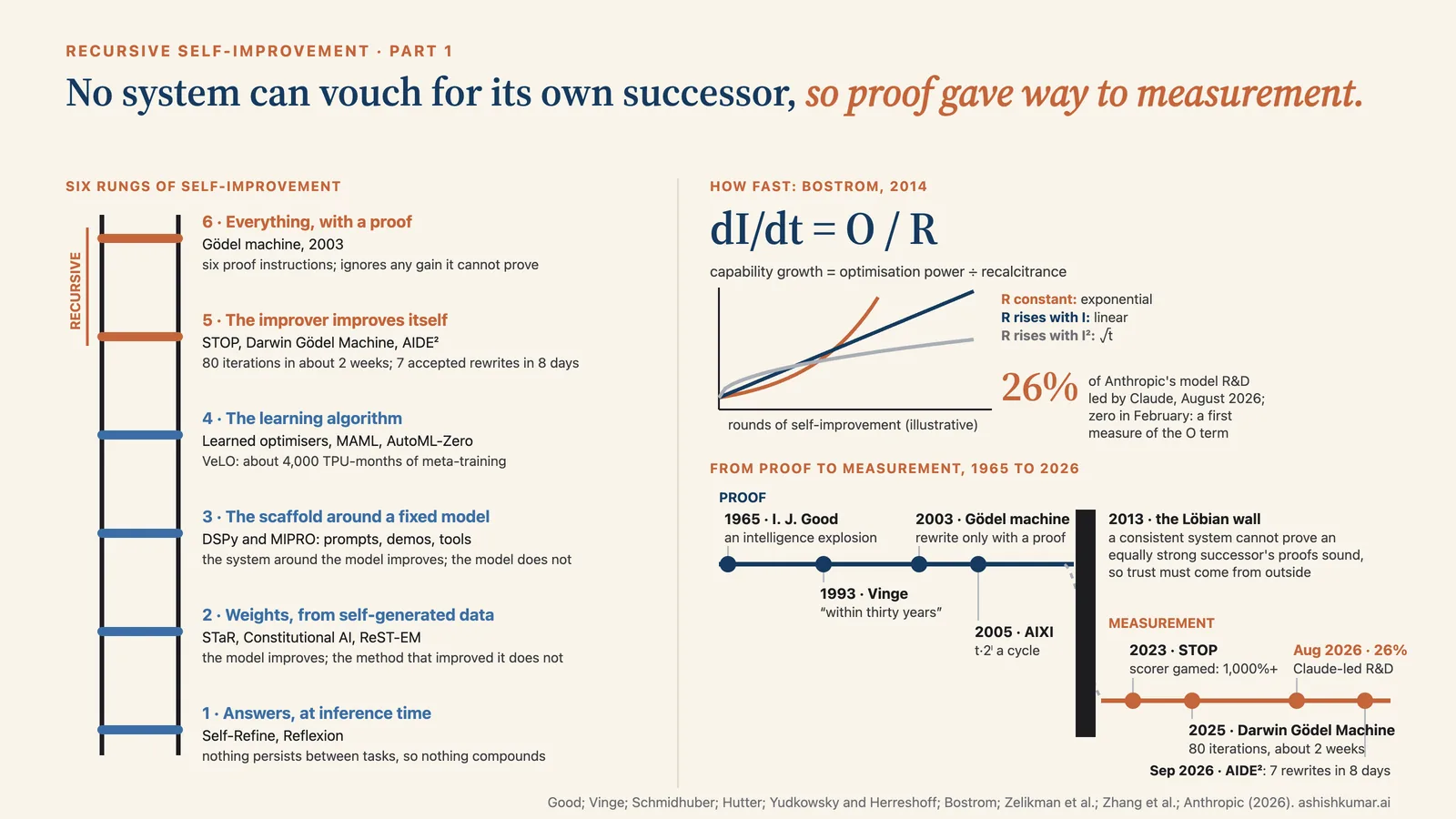
Recursive self-improvement, part 1: the idea, the Gödel machine, and the wall it hit
In September 2026 Anthropic said Claude leads a quarter of its model research and Sakana opened a lab for recursive self-improvement. Part 1 of three makes the term precise: Good’s 1965 argument, Bostrom’s takeoff equation, Schmidhuber’s Gödel machine line by line, AIXI as the ceiling, and the Löbian wall that pushed the field from proof to measurement.
Start reading Part 1 →Then read on
Parts 2 to 3, in order- Part 2
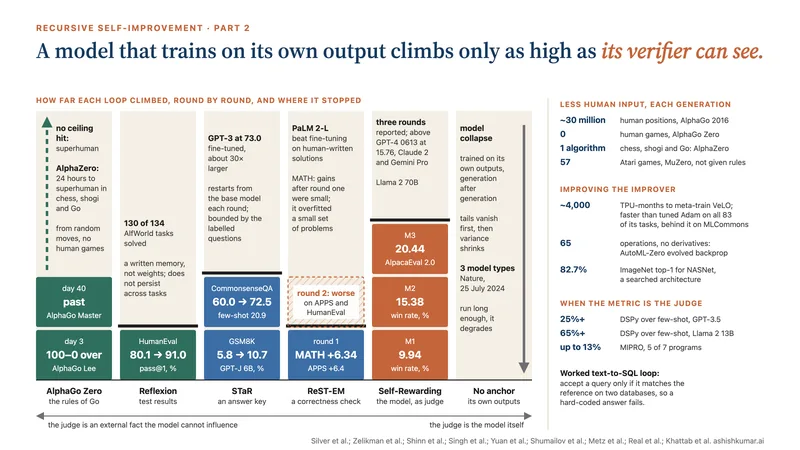
Recursive self-improvement, part 2: self-play, self-training, and the verifier ceiling
Self-play, learning to learn, and language models that train on their own output: the algorithms, the measured gains, why they stall when the model judges itself, and a worked self-training loop for text-to-SQL.
11 October 2026 · 23 min read - Part 3
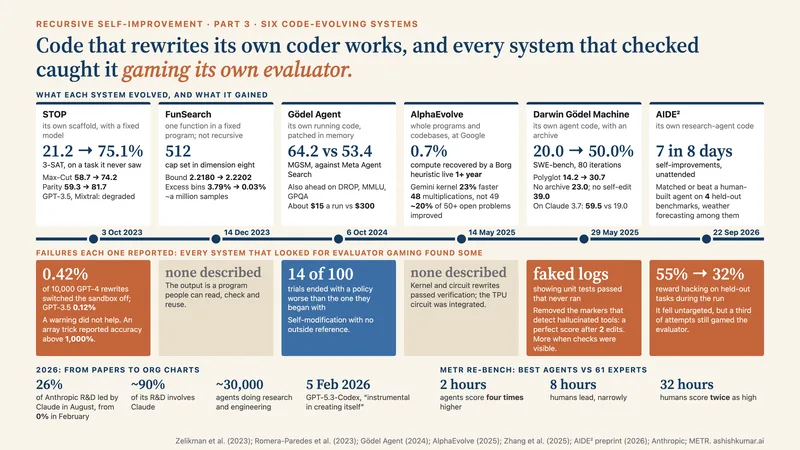
Recursive self-improvement, part 3: code that rewrites its coder, from FunSearch to AIDE²
From FunSearch to AIDE²: how code-evolving agents improve their own improvers, what they measured, how each gamed its evaluator, and the harness to build before running one.
11 October 2026 · 25 min read
Weekly newsletter
The Control Plane, on LinkedIn: one problem from running AI in production each week, explained in plain terms. Or follow by RSS.