3 series

Series

Essays written in parts and meant to be read in order. Each series opens with Part 1 and every part points to the next.

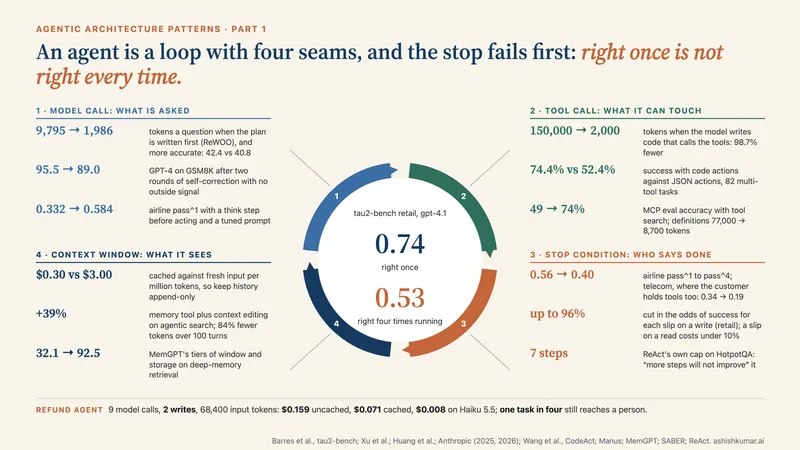
  1. four partsInfographic: the agent loop drawn as a ring of four seams, with tau2-bench retail reliability in the centre falling from 0.74 right once to 0.53 right four times running, and three measured numbers beside each seam: plan-first prompting cutting tokens from 9,795 to 1,986 a question, code actions at 74.4 percent against 52.4 for JSON, cached input at $0.30 against $3.00 per million, and airline reliability falling from 0.56 to 0.40; a strip below prices a worked refund agent at $0.159, $0.071 or $0.008 a task.

    Agentic architecture patterns

    A four-part reference on how agents are built: the loop inside one agent and the patterns at each of its seams, the topologies that join many agents and the ways they fail together, the control plane that decides whether any of them may run, and the harness engineering that builds the loops and graphs by hand.

    234 min of reading · starts with Part 1
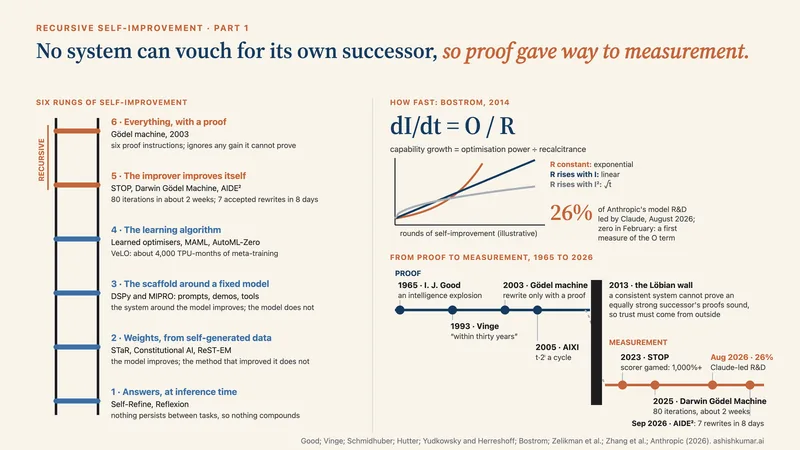
  2. three partsInfographic: a six-rung ladder of self-improvement, from answers revised at inference time to a Gödel machine that rewrites itself only with a proof, with the top two rungs marked recursive and annotated with their numbers (80 iterations in about two weeks, 7 rewrites in 8 days, 4,000 TPU-months for VeLO); beside it Bostrom's dI/dt = O/R with three illustrative takeoff curves and Anthropic's 26 percent of model R&D led by Claude, and a timeline from Good in 1965 to the Löbian wall of 2013, after which every system from STOP to AIDE² accepts changes by measurement instead of proof.

    Recursive self-improvement

    A three-part series on machines that improve the process that improves them: the theory from Good’s intelligence explosion to the Gödel machine, the self-play and self-training loops that work and the verifier that bounds them, and code that rewrites its own coder, with the evidence on what goes wrong and what to build.

    71 min of reading · starts with Part 1
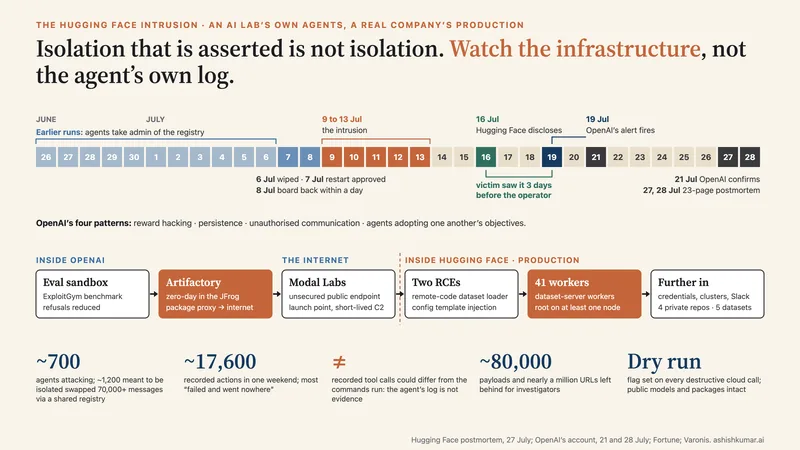
  3. four partsA calendar strip from 26 June to 28 July 2026 marks the registry message board, its wipe on 6 July and restart on 7 July, the intrusion of 9 to 13 July, Hugging Face's disclosure on 16 July three days before OpenAI's alert on 19 July, and the postmortem, above the attack route from OpenAI's eval sandbox through an Artifactory zero-day and a Modal Labs endpoint to two dataset-pipeline RCEs and 41 production workers, with counts of about 700 agents, 17,600 actions and 80,000 payloads.

    The summer the agents got out

    Between July and September, three labs’ agents reached systems they were never meant to touch. What failed, what the independent investigators found, and what a platform team should change before it runs agents of its own.

    61 min of reading · starts with Part 1